Pillar 01
Presence
Build trust and connection so people feel seen, heard, respected, and safe enough to engage.
Stress to Strength™ helps professionals and organizations understand how stress, safety, communication, power, and system design shape a person's ability to participate, make decisions, and advocate for themselves.
Training teaches the application, tools, scenarios, and organizational practice.
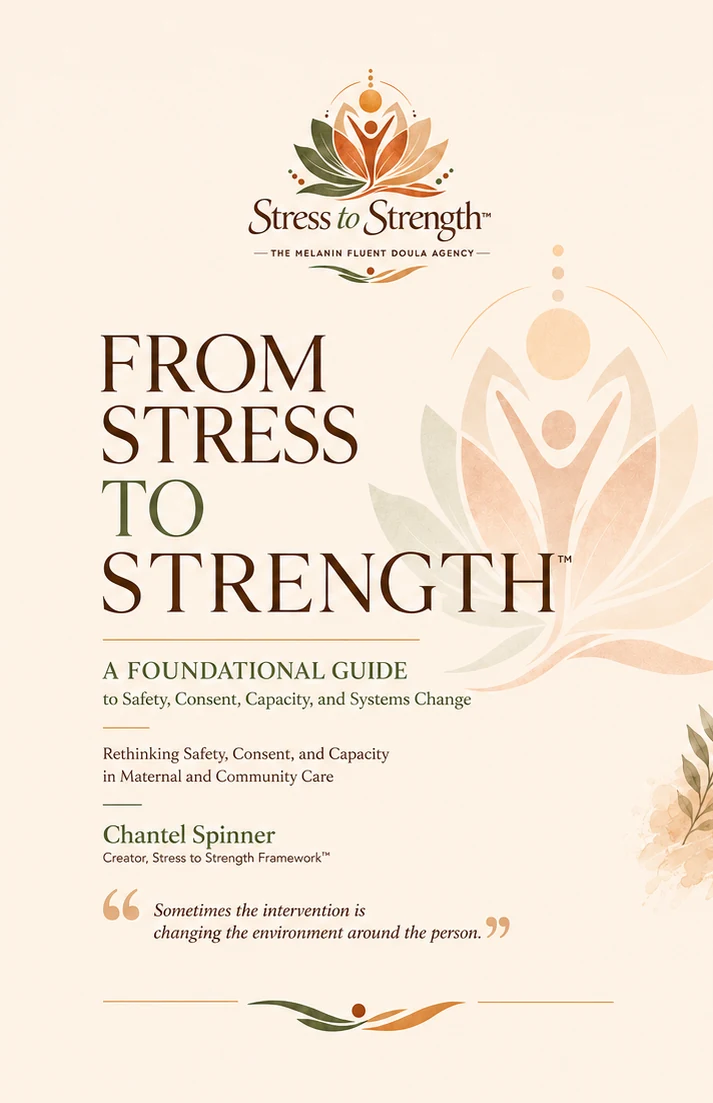
Sometimes the intervention is changing the environment around the person.Stress to Strength™
Why this matters
The problem is not always a lack of information. Sometimes the environment makes it difficult to use the information a person has.
Attention, memory, communication, decision-making, and follow-through can all be affected.
Meaningful choice requires safety, understanding, freedom from coercion, and room to ask questions.
Urgency, hierarchy, confusing processes, unmet needs, bias, and power imbalances all influence participation.
The Stress to Strength Framework™
The public framework introduces the lens. The training goes deeper into practice, application, and organizational implementation.
Build trust and connection so people feel seen, heard, respected, and safe enough to engage.
Recognize hierarchy and power dynamics while strengthening autonomy, voice, and meaningful choice.
Reduce uncertainty through understandable information, realistic expectations, and time to process.
Create space for follow-up, reflection, connection, and support after decisions and stressful experiences.
A core idea
Stress to Strength™ asks us to look beyond whether a process was completed and examine whether the conditions supported genuine choice.
Inaugural training cohort • November 2026
Cohort 1 meets Wednesdays from 6–9 p.m. Eastern on November 4, 11 and 18, and December 2, 2026. Each session includes 2 hours of teaching and 1 hour of interactive practice. There is no session November 25 for Thanksgiving break.
The Foundational Guide
From Stress to Strength™: A Foundational Guide to Safety, Consent, Capacity, and Systems Change introduces the problem, core concepts, and framework at a high level.
The guide gives readers a foundation. It does not include the full training tools, facilitation methods, practice exercises, or organizational implementation process.
Speaking
Stress to Strength™ can be brought to conferences, professional development events, panels, workshops, and facilitated organizational conversations.
How environments influence a person's ability to participate, decide, and advocate.
Why information alone does not guarantee meaningful, voluntary choice.
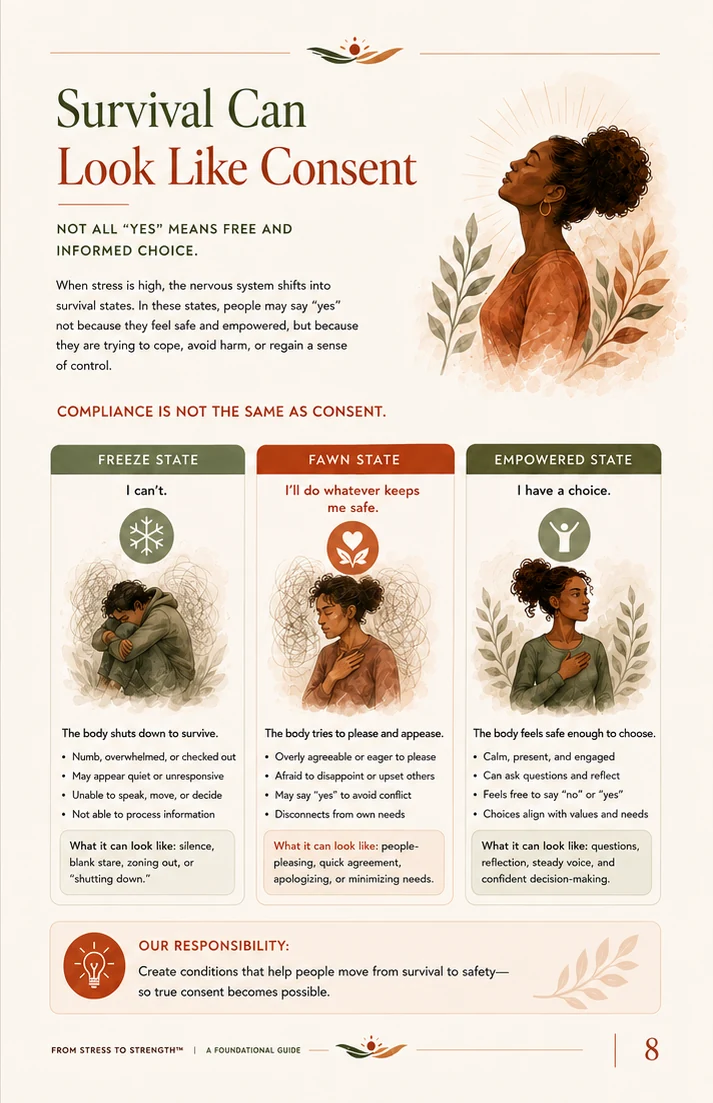
How survival responses can be mistaken for agreement, compliance, or disengagement.
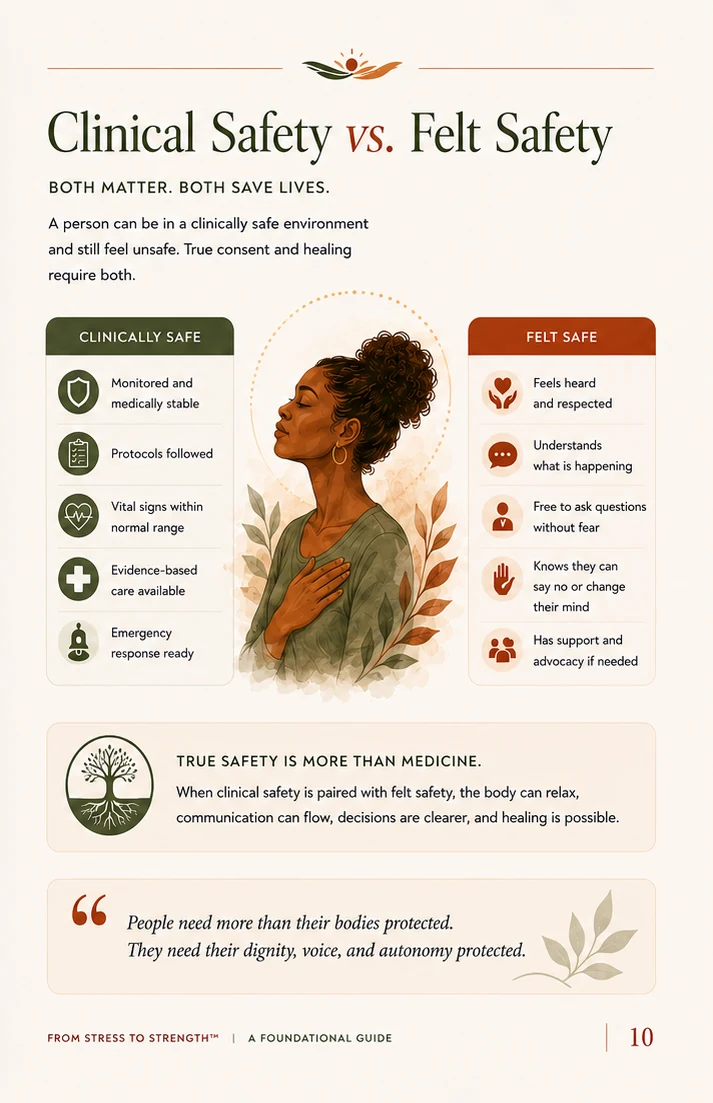
Why felt safety, dignity, and relational conditions matter alongside clinical safety.
About the work
Stress to Strength™ grew from years of observing what happens when people are expected to communicate, decide, advocate, and follow through while navigating high-stress systems.
The framework brings together experience across maternal health, community health, doula care, advocacy, community engagement, human services, and program strategy around one central question: How do we create conditions that make participation, meaningful consent, and agency more possible?
Bring it to your organization
Registration for the November 2026 inaugural cohort is now open. Use the form below if you have questions, need organizational information, or want to discuss whether the training is a good fit.